
My Unblinking Eyes
The view from the Statue of Liberty - and what its Egyptian origins tell us about ourselves today.

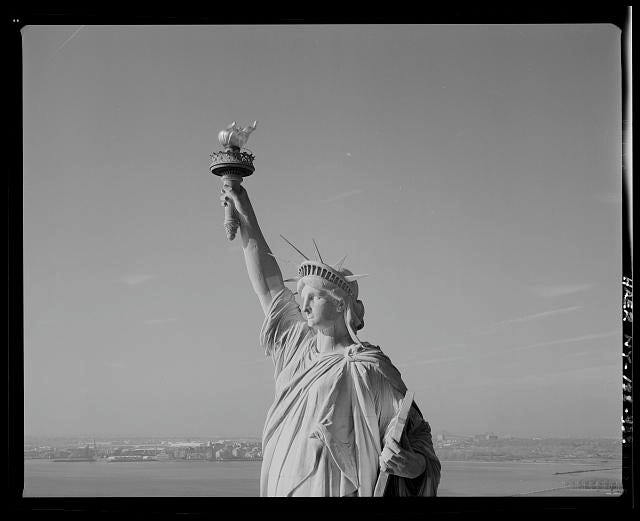
I’ve seen much in my 140 years. Immobile though I’ve been, mine eyes have seen a country, a continent emerge on the global stage.
These unblinking eyes, like some sleepless sentinel, some soundless sentry. Unable to defend, but able to stir, to stir the emotion of people the world over for the symbol I’ve become, this symbol of liberty, for which I am named.
These “mild eyes,” as Emma Lazarus calls them, have seen the dawn of aviation. Wilbur Wright circled me in a public demonstration of his flying machine in some long ago September. In a more recent September, a quarter of a century ago, these same mild eyes couldn’t bat away the smoke from the destruction caused by the total weaponization of his invention.
For the death, my clothes felt less like robes than they did a funeral shroud.
In time, the smoke cleared and the sea sparkled once again. Its sparkle reminds me of the glint I once saw in my builder’s eye. What so many dismissed as craziness I saw as my genesis.
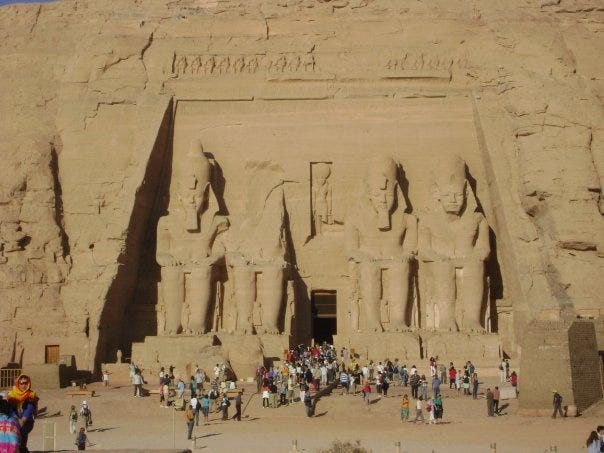
In that seeing, I found a reflection of some distant memory of Frédéric Auguste Bartholdi. I saw an imagination fired by inspiration born of his visit to Abu Simbel in Upper Egypt. His wonder at the gigantic statues of Ramses II, his determination to build something on a scale such as that.
He focused his energies on a light-bearing statue to grace the entrance of the Suez Canal. Completed in 1869, the canal was built on the backs of Egyptian labor and overseen by his fellow Frenchman, Ferdinand de Lesseps. It was to be called Egypt Bringing Light to Asia, with a veiled Egyptian peasant woman holding aloft a lantern.
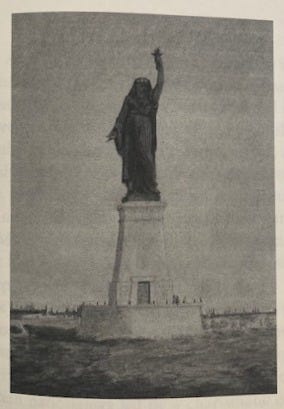
The funding of it all was the problem, though, and Egypt Bringing the Light to Asia never came to be.
Egypt’s loss gave life to me.
Amidst his disappointment, when Bartholdi entered New York harbor in 1871, when he saw Bedloe’s Island, he found a new place for his genius. Overtime, Egypt Bringing Light to Asia became Liberty Enlightening the World. He refashioned an Egyptian peasant woman into me. Her veil became my crown. Her lantern became my torch.
Now I carry the flame.
By that light, I hope you can read what Lazarus wrote about me on the pedestal upon which I stand. I hope you see me as the manifestation of the moniker I can only hope to live up to: Mother of Exiles. Her words breathe life into what I strive to symbolize in my oxidized form.
While Lazarus cautions the ancients to keep their “storied pomp,” I encourage you not to forget that my being stems from them. Them. Those people over there. Over there. The Middle East. Egypt.
I know many beyond this “golden door” of ours who continue to have knee-jerk aversions to anything or anyone “over there.” They point to reasons for this. They point to Mohamed Atta, the lead hijacker on 9/11, who was from Egypt. They point to Ayman al-Zawahiri, the right-hand man to Osama bin Laden and subsequent leader of al-Qaeda, who was also from Egypt. They point to individuals who would divide and destroy, while neglecting the millions of others who would unite and build.
We’re lost if we neglect the interconnectedness of “us” and “them.” We’re lost if we neglect the history that joins together two different places and two different people across time and space, met in me. We’re lost at sea without the guidance of a lighthouse if we neglect to learn about the paths that came before us, the routes that led to Luxor, to the Suez Canal, to Bedloe’s Island, that led to me in the first place.
If we neglect the backstory, we’ll miss the plot entire.
What I’ve seen is of little consequence compared to what I will see. The events I’ll witness will be the result of people whose eyes are closed or open, whose minds’ eyes are shut or full of wonder. I carry my “imprisoned lightning” so that man and woman may live free, not so that they may be bound by untested, preconceived notions. I carry it for all those “yearning to breathe free” - including free from unwarranted associations that say more about “us” than they do about “them.”
As for me, my “beacon-hand” will remain aloft. My unblinking eyes will remain open.
Additional resources for this article are available below:
Power, Faith, and Fantasy: America in the Middle East, 1776 to the Present by Michael B. Oren (see page 269)
Parting the Desert: The Creation of the Suez Canal by Zachary Karabell (see page. 242-243)
Thank you for reading my latest installment of “25 Weeks to 25 Years,” a 25 week series leading up to the 25th anniversary of 9/11 later this year.
Prior installments include:
July 24: Going Back to Where I’m From
July 17: Libraries and Terrorism
July 10: Happy Birthday, Charles Laurencin
July 3: An Airshow and Maryland’s 9/11 Rolling Memorial
June 26: Born on 9/11
June 19: Pakistan, Pakistanis, and Pakistani
June 12: Three Months Before 9/11
June 5: D-Day, Pearl Harbor, 9/11
May 29: Pop, The Discoverers, and a Cape You’ve Never Heard Of
May 22: Memory Palace and Four Freedoms
May 15: McCullough and Memory
May 8: Dostoevsky and the Legacy of 9/11
May 1: On the Road to bin Laden’s House
April 24: Here Comes the Hard Part
April 17: The Boston Marathon and the BPL
April 10: A Pilgrimage to Ground Zero
April 3: The Other Twin Towers
March 27: 47 Years On From the Egypt-Israel Peace Treaty
March 20: The Iraq War - 23 Years Later
March 17: 25 Weeks to 25 Years
Lady Liberty is more complex than I had realized