
McCullough and Memory
What a 1986 commencement address by David McCullough tells us about the importance of travel, the past, and the memories we should never forget.

Graduation season is upon us. With commencement comes commencement speeches.
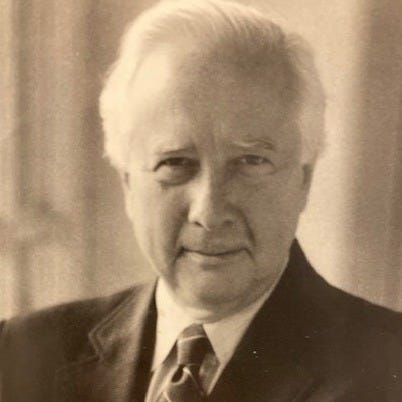
My favorite is from three years before I was born. David McCullough delivered it to Middlebury College’s graduating class of 1986. (I am certainly biased in this regard, given that McCullough is a favorite author of mine and for the reason that that small school in rural Vermont would become my alma mater years later.)
The speech is the penultimate chapter in his book, Brave Companions. It’s called, “Recommended Itinerary.”
As the title suggests, McCullough’s address is an inducement to travel, to see the world - and, importantly, one’s own country with one’s own eyes.
He speaks of Florence, of Edinburgh, of Palenque in Mexico, but also about Monticello, of Illinois, of Red Cloud, Nebraska. He talks about Kentucky, not “far-off, who-gives-a-damn-about-it, good-for-nothing, backwoods hillbilly Kentucky, but your Kentucky, your country.”
McCullough could just have easily replaced the word “history” for “Kentucky” and the meaning would be about the same.
He was, after all, a historian. One of the greatest this country - your country - has produced. He asks his audience:
“How can we know who we are and where we are going if we don’t know anything about where we have come from and what we have been through, the courage shown, the costs paid, to be where we are?”
He then relates an anecdote from his own experience. He speaks of a lunch he had with a friend in Washington, DC. At some point in the conversation, he had mentioned Antietam, to which his friend responded, “What is Antietam?”
Trying to give his companion the benefit of the doubt, he suggested that perhaps she was familiar with it as Sharpsburg. Still, the name did not register.
![[Antietam, Md. Confederate dead by a fence on the Hagerstown road]](https://substackcdn.com/image/fetch/$s_!a4of!,f_auto,q_auto:good,fl_progressive:steep/https%3A%2F%2Fsubstack-post-media.s3.amazonaws.com%2Fpublic%2Fimages%2Fdddb1453-7036-4872-9300-f941619a870c_640x515.jpeg "[Antietam, Md. Confederate dead by a fence on the Hagerstown road]")
As McCullough relates, the Battle of Antietam on September 17, 1862 was then - and remains now - the bloodiest day in the history of the United States. In one day, some 23,000 casualties were inflicted. What blew McCullough away was the fact that this battle in Maryland had “happened hardly more than an hour’s drive from where we were sitting, and she had never heard of it.”
How true does that same line hold for any number of other places and events and people in our nation’s history. The difference between having never heard of something and forgetting what one might have previously heard about it is a small one. It reminds me of what Mark Twain had to say about literacy: “The man who does not read has no advantage over the man who cannot read.”
Indeed, it’s hard to remember something we’ve never bothered to learn anything about. The threshold for remembering, though, is much more accessible for those events that we experienced, that we witnessed ourselves. In other words, events like 9/11.
Yes, a whole generation now has come of age since the terrorist attacks that day.
But to say that 9/11 happened so long ago is to dismiss not only the impact it has had on who we are as a people today, but to neglect the memory of those whom we told ourselves we would never forget.
Yes, you should go to the 9/11 memorial at the Pentagon and certainly the memorial at Ground Zero in New York City. But you should also go to Shanksville, Pennsylvania, as well.
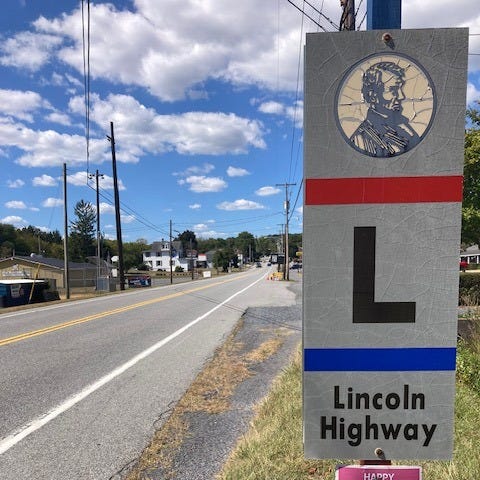
You should drive along the Lincoln Highway - the country’s first coast-to-coast road - before taking a turn on Approach Road, passing by the 93-foot-tall Tower of Voices, and continuing on down to the Visitors Center at the Flight 93 National Memorial.
You should walk the line that charts the flight path of United Flight 93 as it made its final, rapid, uncontrolled descent, a line timestamped with the other attacks that had transpired that morning. You should walk out to the end of the overlook and take in the view of the hallowed ground.
It has all the feel of a battlefield.
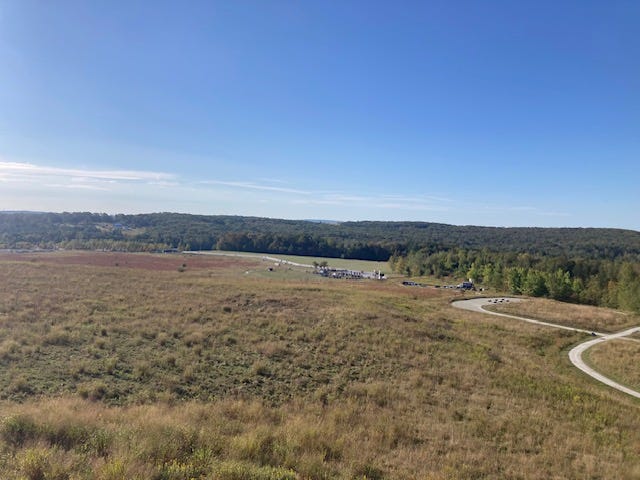
You should see the great stone that marks the point of impact. You should take a minute, take an hour to remember that, but for the collective sacrifice - “the courage shown, the costs paid” - of those passengers and crew, the plane was headed for the U.S. Capitol. If the greatest thing man can do is to lay down his or her own life for friends, how greater still is the sacrifice of a stranger for a stranger.
McCullough ends his speech with the rhetorical question of when to set out on such travels. He cites former U.S. Senator George Aiken of Vermont and his response to an inquiry about pruning trees.
“Some say you shouldn’t prune except at the right time of year. I generally do it when the saw is sharp.”
Thank you for reading my latest installment of “25 Weeks to 25 Years,” a 25 week series leading up to the 25th anniversary of 9/11 later this year.
Prior installments include:
May 8: Dostoevsky and the Legacy of 9/11
May 1: On the Road to bin Laden’s House
April 24: Here Comes the Hard Part
April 17: The Boston Marathon and the BPL
April 10: A Pilgrimage to Ground Zero
April 3: The Other Twin Towers
March 27: 47 Years On From the Egypt-Israel Peace Treaty
March 20: The Iraq War - 23 Years Later
March 17: 25 Weeks to 25 Years
Good to bring up Shanksville. ". . .when the saw is sharp." I like that.