
Three Months Before 9/11
Three months before 9/11, Timothy McVeigh was executed for his role in the Oklahoma City Bombing.


We couldn’t have known it then, of course. Least of all me. I was just a 12-year-old sixth grader getting dropped off at school by my Dad. Summer was right around the corner.
My Dad pulled over off First Ave, right by the sign that marks the building from the road as JAMES H. ELDREDGE ELEMENTARY SCHOOL. The eagle on the sign carries no arrows, no olive branches in its talons. East Greenwich, Rhode Island felt about as far away as one could get from Terre Haute, Indiana.

Yet it would be news from the Hoosier State that kept me at the car door before heading to class. Far from the Loren & Wally Morning Show we usually listened to on 105.7 WROR, the radio was tuned to weightier events.
What I remember about that extended moment was the gravity of the male voice coming through the speakers of the Chevy Tahoe. It was a voice so unlike the cadences and lilts of newscasters today. His words gave confirmation to what we had waited to hear: Timothy McVeigh had been executed by lethal injection.
It was the morning of June 11, 2001.
Three months to the day before 9/11.
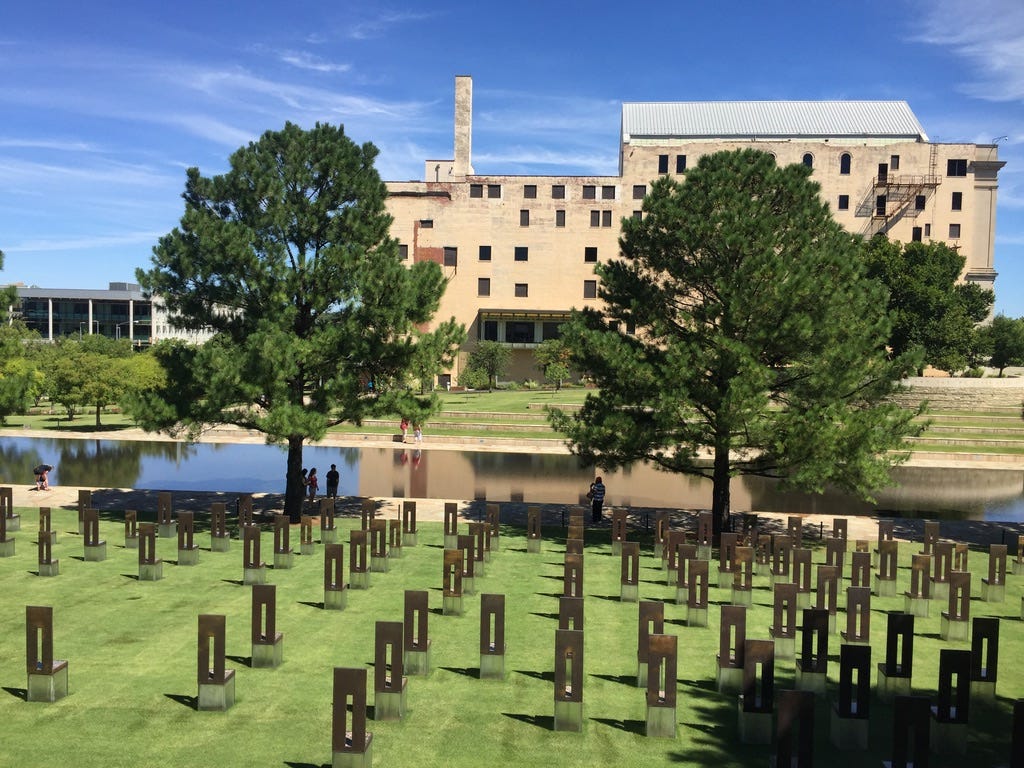
I remember the gravity of that moment more than I did the bombing in the first place. The Oklahoma City Bombing had happened six years before then, half of my life at that point. I didn’t remember the killing of the 168 people when McVeigh ignited 4,800 pounds of explosives at the foot of the Alfred P. Murrah Building. I would only remember the images of the side of a building shorn off that filled the airwaves in the lead up to the execution.
I didn’t remember the bombing - I only remembered the reminders of it.
Timothy McVeigh was its starkest reminder. He was a reminder that we decided needed to be erased.
When the news of his death was confirmed, I remember feeling heavy. No lightness, no sense of retribution, no peaceful, easy feeling. Just a weight. It was the weight of a bystander, some looker-on who wanted to experience the finality of such an act as an execution, but one who didn’t know what to do afterwards.
How do you handle the death of another, even if he’s a terrorist?
My memory of that morning is less “A Hanging” by George Orwell and more the reminiscence of Samuel Hamilton of John Steinbeck’s East of Eden. Perhaps the father-son dynamic in the latter plants it more firmly in my recollection of that long ago morning with my Dad.
“It’s no thing for a child,” Samuel’s father says, trying to break free with young Sam from a crowd gathered to witness a hanging. “It’s no thing for anybody, but less for a child.” Unable to pull away, he wraps his hands around Sam’s ears and pulls his head against his chest, trying to protect him from the sights and sounds of the spectacle.
Afterwards, in a pub, Sam’s father answers his son’s question about what they witnessed. “I’ll have to tell you. They were killing a bad man… And you must put no sorrow on him. He had to be killed. Not once but many times he did dreadful things - things only a fiend could think of. It’s not his hanging sorrows me but that they make a holiday of it that should be secretly, in the dark.”
What I didn’t know then is that three months later I’d be at a new school bearing witness to the worst terrorist attack our country has ever known.
What I didn’t know then is that ten years later, I’d be watching TV in a room packed full of classmates in college listening to the President of the United States announce that Osama bin Laden had been killed in a U.S. Navy SEAL raid.
I remember the celebrations after bin Laden’s killing. I remember being unable to bring myself to join in them.
What I didn’t know, what I didn’t realize until writing this piece is that the heaviness I felt in the wake of the news about bin Laden was the same sort of heaviness I felt when the news came that Timothy McVeigh was dead.
The Oklahoma City Bombing was not 9/11. Timothy McVeigh and Osama bin Laden were not one in the same. I’m not trying to make connections that would be as incorrect as they would be improper.
I know not the pain of a victim, or a friend or family member of a victim of either of those acts of terrorism. I know not the thirst for justice or outright vengeance that could understandably animate some who were directly affected by these and other acts of terrorism.
My sorrow is not on the men who committed these acts, but on us.
Because the struggle to move beyond the hate, intolerance, and fundamentalism that gives rise to evil forces in the first place is our responsibility. It is a heavy, weighty responsibility at that.
Yet we can’t overcome the rightful pain of the past with boisterous boasts of our own superiority in the present. It’s slippery language that leads to slippery behavior, action without reflection, prejudice without personal examination. In other words, it’s behavior that leaves us ignorant of root causes, disinterested in others, indifferent to neighbors and allies alike.
It’s a heavy, weighty responsibility and we must engage with it if we are to emerge from it.
Thank you for reading my latest installment of “25 Weeks to 25 Years,” a 25 week series leading up to the 25th anniversary of 9/11 later this year.
Prior installments include:
June 5: D-Day, Pearl Harbor, 9/11
May 29: Pop, The Discoverers, and a Cape You’ve Never Heard Of
May 22: Memory Palace and Four Freedoms
May 15: McCullough and Memory
May 8: Dostoevsky and the Legacy of 9/11
May 1: On the Road to bin Laden’s House
April 24: Here Comes the Hard Part
April 17: The Boston Marathon and the BPL
April 10: A Pilgrimage to Ground Zero
April 3: The Other Twin Towers
March 27: 47 Years On From the Egypt-Israel Peace Treaty
March 20: The Iraq War - 23 Years Later
March 17: 25 Weeks to 25 Years